
What players say
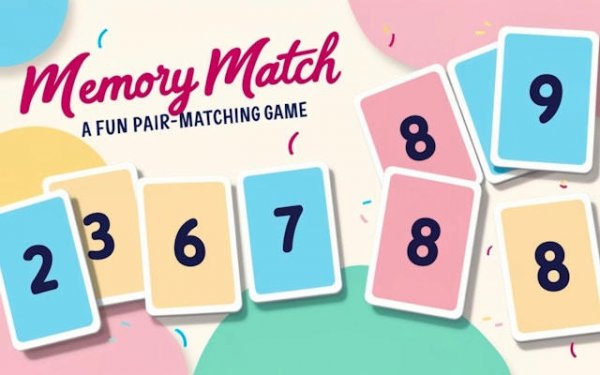
Memory Match: Pair Discovery Puzzle strips the genre down to its core: flip two cards, remember what you saw, and clear the board. The absence of a timer makes it more about careful recall than quick reflexes, which suits younger and older players. Progression is handled entirely by increasing the number of pairs, so the rules stay consistent while the memory load grows. The instant restart option turns any level into a practice drill. It is not a game of complex modes or flashy extras, but it does its one job well.
About this game
How a Turn Unfolds
Each turn begins with a click or tap on a face-down card. It flips to show a symbol. You then choose a second card. If the symbols match, both remain face-up and you earn points. If they do not match, the cards flip back after a short delay. The board is only cleared once every pair has been matched. There is no timer, so you can deliberate on each selection without pressure. This shifts the challenge entirely to memory and visual scanning rather than speed.
Progression by Pair Count
Difficulty rises only through adding more pairs to the grid. Early boards are small and quick to clear, helping you settle into the rhythm of flipping and remembering. Later boards demand stronger short-term recall and better visual scanning because more symbols compete for your attention. The core rule never changes, but the memory load increases. This simple progression extends play without introducing new mechanics or modes.
Restart as a Practice Tool
The restart option lets you replay any level immediately. That turns each board into a repeatable drill. You can try a level again after a poor run, experiment with memory strategies, or aim for a better score. It also removes the friction of waiting to try again, making practice feel seamless.
Who It Suits
The design targets a wide audience: kids, adults, and seniors can all play without prior gaming experience. The interface is clean and friendly, keeping the focus on the cards themselves. To improve, try to remember the positions of cards even when they do not match, since that information becomes useful on later turns. Taking your time and staying calm tends to produce more efficient matching than rushing. Regular short sessions can help sharpen visual recognition and short-term memory.
Compatibility
FAQ
Player Comments
Sign in to comment
You must be logged in before posting a review or rating.
No comments yet. Be the first to comment!


Editorial Notes