
What players say
One Touch Logic Puzzle is a spatial reasoning exercise built around a single rule: one continuous line, no retracing, every illuminated point covered. The undo button softens mistakes, and the gradual difficulty curve teaches the mechanic without overwhelming newcomers. Bright dots on a dark background keep the path readable. Its main limitation is the genre itself: if you want action or fast feedback, the deliberate pace will not hold you.
About this game
Reading the Grid Before You Draw
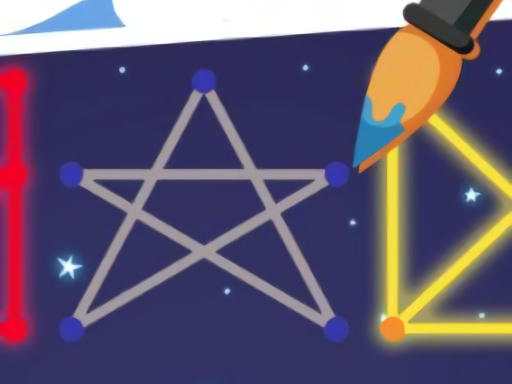
Every level presents a grid marked with illuminated points. The objective is to trace one continuous line that passes through all of them. You cannot lift your finger or mouse, and you cannot retrace a segment you have already lit. The line begins at a designated aperture and ends wherever the pattern permits. Because each puzzle has exactly one valid solution, random swiping rarely succeeds. The real work happens before you draw: studying the arrangement, spotting symmetry or repeated shapes, and mentally testing a route.
Undo, Hints, and the Cost of a Wrong Turn
This is not a reflex game. A wrong turn early in a route usually forces a restart, which is why an undo button is available. It lets you back out of a failed path without wiping the entire attempt, turning each mistake into a learning step. Hints are offered when you stall, though the design clearly nudges you toward solving unaided. The challenge sits in spatial reasoning, not speed.
Visual Clarity and Difficulty Progression
The sci-fi-inspired light effects serve a practical purpose. Bright dots against a darker background make the illuminated path easy to read at a glance, which matters when you are tracking which segments are already covered. Difficulty climbs gradually. Early grids teach the basic one-stroke rule, while later ones demand longer, more tangled routes. That pacing helps newcomers learn without hitting a wall, while experienced puzzle players still find later grids worth chewing on.
Who This Suits
Anyone who enjoys visual logic challenges can pick this up, including younger players, since the design is family-friendly and the controls are just tap-and-drag. Sessions can be short or long depending on how many puzzles you attempt. The main limitation is inherent to the genre: if you dislike abstract grid puzzles or prefer action, the slow, deliberate pace will not hold your attention.
Compatibility
FAQ
Player Comments
Sign in to comment
You must be logged in before posting a review or rating.
No comments yet. Be the first to comment!


Editorial Notes